_edited_edited.jpg)
Practical Python Execution Systems Built Around Your Trading Workflow
Many traders eventually start exploring Python after hitting limitations with rigid no-code platforms or bridge-based execution setups, or reaching a stage where flexibility, execution control, dashboards, scanners, integrations, and operations become difficult to manage properly.
We help structure and develop practical Python-based systems around how traders actually want to execute, monitor, automate, and manage operations in live market conditions.
Python allows flexibility across:
-
Broker API integrations
-
Live market data handling
-
Strategy automation systems
-
Scanner & alert systems
-
Dashboards & monitoring
-
Backtesting & execution controls
Why Many Traders Eventually Move Towards Python Systems
Although many traders already use separate no-code, charting, scanner, alerts, execution bridge, dashboard, and market-data tools for different parts of execution, bringing everything together properly and maintaining stable execution during live market conditions usually becomes the bigger challenge over time.
This is where Python-based execution systems are often explored for building more structured automation infrastructure with better execution control, integrations, monitoring, operational flexibility, and a more private execution environment.
Commonly Requested Features & Controls
• Multi-indicator and multi-timeframe execution
• Stock/index to options execution logic
• Intraday and positional timing controls
• Stop-loss, trailing systems, targets, re-entries
• Strategy-level risk and MTM handling
• Quantity and order management systems
• Scanner and dashboard integrations
• Execution monitoring and operational controls
Broker API Integration
Backtesting Engine
Order & Risk Management
Logic-Driven Alerts
Web-Based Python Execution Systems:
• Useful for native or cloud-hosted/live website-based dashboards with custom layouts, multi-screen visibility, and multi-user monitoring workflows
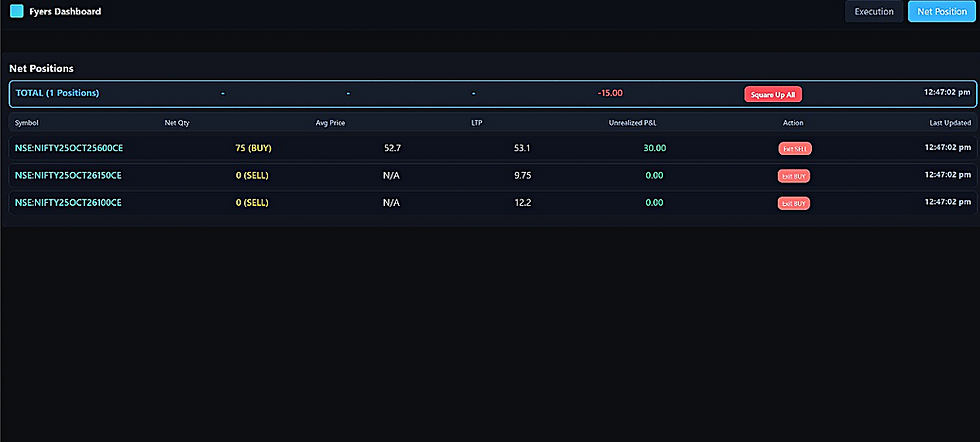
• Supports live order-book visibility, net positions, execution controls, discretionary order buttons, basket-order workflows, and UI/theme customization
• Commonly preferred for centralized operational management systems ranging from smaller setups to larger execution infrastructure environments

Non-Web Based Python Execution Systems:
-
Usually preferred for private local/VPS-based execution environments and focused automation systems
-
Suitable for single-strategy, strategy-specific, or lower operational management requirements
-
Often explored during initial automation stages before later upgrading towards frontend UI dashboards or larger web-based infrastructure if required

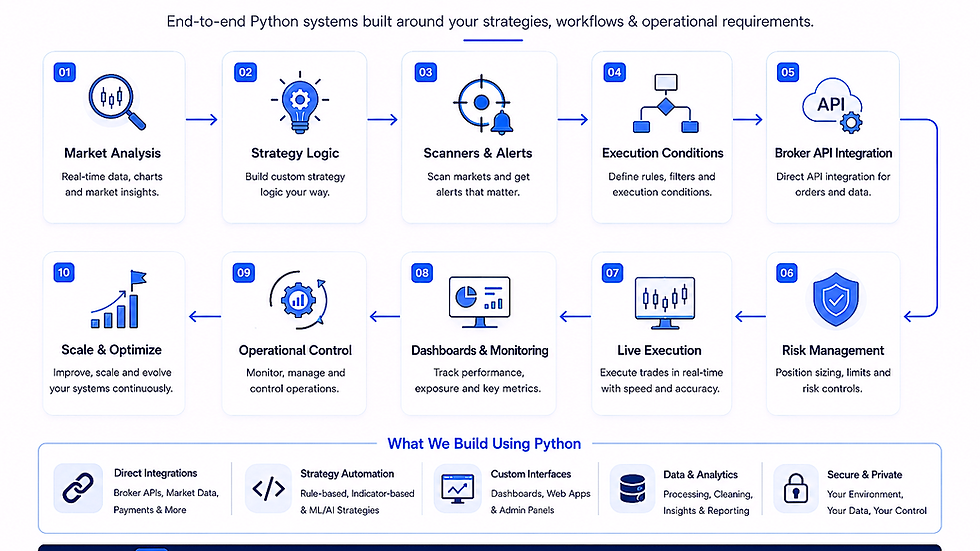


End-to-End Python System Development
Every system is custom built around your execution setup, operational structure, dashboards, monitoring requirements, and trading style.
✅ Custom Strategy Development: EMA, RSI, VWAP, divergence systems, options workflows, multi-leg structures, or discretionary execution logic.
✅ Backtesting & Optimization: Validate strategies on second-level or tick-by-tick data before moving towards live execution.
✅ Broker API & WebSocket Integration: Connect market data, live execution, order handling, and broker infrastructure seamlessly.
✅ Execution Automation: Structure end-to-end execution from scanning and signals to live order execution.
✅ Risk Controls: Smart SL, trailing systems, capital allocation, position sizing, error handling, and emergency kill-switch controls.
✅ Custom Dashboards & Platforms: Monitor symbols, positions, scanner outputs, metrics, alerts, execution activity, and operational controls from a centralized dashboard.
✅ Data & Reporting: Import/export data, trades, signals, reports, logs, and system outputs for further analysis and monitoring.
✅ Deployment & Support: Systems can be structured around local machines, VPS setups, or cloud-based execution environments depending on the requirement.
Whether you're a solo trader managing a single strategy or handling multiple execution systems across different accounts, the focus remains the same: stable, practical, and fully owned execution infrastructure.
SHARE YOUR REQUIREMENT:
TYPICAL DEVELOPMENT WORKFLOW
-
Requirement Understanding
-
Workflow Planning
-
System Architecture
-
Dashboard & Scanner Development
-
Execution & Monitoring
-
Testing & Deployment
-
Broker/API Integrations
-
140+ Supported Broker Infrastructures
-
Indian & International Market Support
-
Fully Custom-Built Systems
Discuss Your Python System Requirement
Whether you're exploring a new automation requirement, dashboard system, scanner infrastructure, broker integration, or improving an existing execution setup, discussions typically revolve around:
✅ Feasibility and implementation approach
✅ Integrations and operational setup
✅ Dashboards, scanners, and monitoring requirements
✅ Automation handling and risk controls
✅ Development timelines and implementation direction
PYTHON SYSTEM DEVELOPMENT PRICING
Below are indicative base pricing examples for Python execution infrastructure and platform development. Final scope and costing may vary depending on your strategy requirements and implementation scope.
1. Python Strategy & Execution Systems
32,999₹- Market Data Integrations
- Order API Integrations
- WebSocket Connectivity
- Desired Broker Integration
- Private Execution Systems
- Execution-Ready Infrastructure
- Non-Web Based System Development
2. Web-Based Python Platforms/Dashboards
54,999₹- Market Data Integrations
- Order API Integrations
- WebSocket Connectivity
- Desired Broker Integration
- Private Execution Systems
- Execution-Ready Infrastructure
- Web-Based Platform Development
- Custom Dashboards & Monitoring
- Browser-Based Execution Workflows
The above base pricing mainly covers the one-time per broker/API setup, execution infrastructure, connectivity layers, and platform development. Any new strategies can usually be integrated on the same system without rebuilding the infrastructure again. This also helps reduce recurring costs around full-stack rebuilding, third-party bridge tools, and live data subscriptions.
Watch the demo videos below for both Non-Web and Web-based full-stack Python applications.
Typical Python Execution Environment Requirements:
-
Windows 10/11, Ubuntu, or macOS
-
Intel i3/i5/Ryzen multi-core processor preferred
-
4–16 GB RAM depending on workflow complexity
-
Stable broadband internet connection
-
VPS/cloud setup optional for 24/7 execution
-
Static IP may be required for live execution systems